

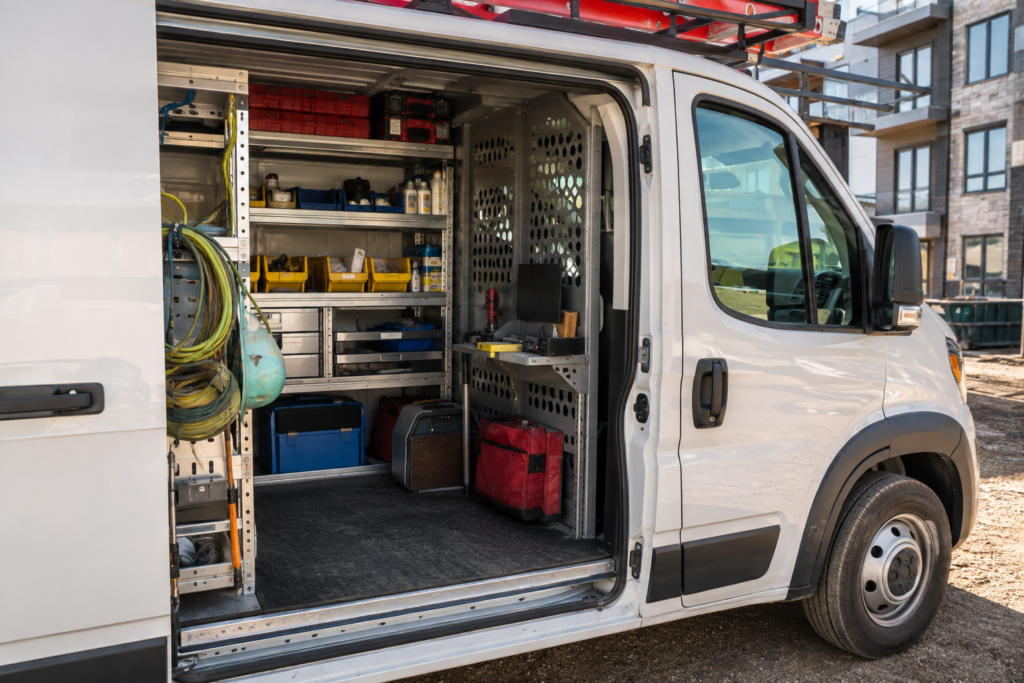
An Inefficient Van Costs More Than Storage Space
For contractors, a poorly organized work van can create small delays throughout the day. Time gets lost searching for tools, moving equipment out of the way, checking for supplies, or unloading items just to reach something stored behind them.
Those interruptions may happen several times across multiple service calls. The issue is not simply whether the van has enough storage space. It is whether the cargo area supports the way the contractor actually works.
A planned approach to van upfitting in Waterloo can address these problems by organizing the cargo area around equipment, inventory, and daily access requirements. Instead of treating the van as an empty space that needs accessories, the planning process considers how it functions as part of the business.
Start With Workflow Before Choosing Van Accessories
An efficient work van starts with understanding the job, not choosing shelves or accessories. Contractors should first consider what they carry every day, which tools are accessed most often, what requires secure storage, and how employees move through the cargo area.
It is also useful to identify recurring frustrations with the current setup. A technician may regularly need to move several cases to reach a frequently used tool, for example, or discover that small parts have no consistent storage location.
A complete professional van upfitting plan can account for these requirements before the final layout is determined. This workflow-led approach helps ensure that individual storage components contribute to a practical overall system.
Put Frequently Used Tools Where They Are Easy to Reach
Not every item in a contractor van needs the same level of accessibility. Equipment used on nearly every service call should generally be easier to reach than tools carried only for occasional tasks.
Well-planned van shelving systems can create defined locations for tools, parts, consumables, and other everyday inventory. The objective is to reduce unnecessary searching and unloading rather than simply fill available wall space.
Consistent storage locations can also make it easier to notice when commonly used supplies need replenishment. The article on how van shelving improves productivity for contractors provides additional context on the relationship between organized storage and daily workflow.
Shelving Capacity Is Not the Same as Good Organization
It can be tempting to measure a van storage system by how many shelves, bins, or compartments fit inside. Maximum storage capacity, however, does not necessarily produce the most practical work van organization.
A useful layout needs to account for equipment dimensions, weight, inventory levels, access requirements, and the space needed for larger tools or materials. Packing too much storage into the cargo area can make equipment harder to reach or leave inadequate room for items that do not fit neatly on shelving.
Contractors also need to consider what changes from job to job. A vehicle may carry a consistent set of tools while requiring flexible space for different materials or project-specific equipment.
These considerations are particularly important when planning van shelving systems for Kitchener-Waterloo for trades and service businesses operating locally.
Separate the Driver Area From the Working Cargo Area
The relationship between the cab and cargo space is another part of the overall van configuration. The two areas serve different purposes, so the transition between them should be considered during the planning process.
Van partitions provide separation between the driver area and the working cargo area while helping define how the interior space is organized. Their role should be considered alongside shelving, equipment placement, cargo requirements, and how workers need to use the vehicle.
The appropriate partition configuration depends on the vehicle and its intended use. Contractors can review additional factors involved in choosing the right van partition for work vehicle safety when evaluating this part of an upfit.
Design Around the Contractor’s Actual Trade
An electrician, plumber, HVAC technician, installer, and general contractor may use similar commercial vans but carry very different equipment. Even two businesses in the same trade can have different storage requirements based on the services they provide.
An electrician may need organized access to small components, tools, and supplies. A contractor carrying larger equipment may place greater importance on open cargo space. An installer may need to balance tool storage with room for materials being transported to individual jobs.
The purpose of work van upfitting is not to prescribe one layout for every contractor. It is to understand what needs to be carried, how frequently each item is used, and where current storage problems interfere with the work.
That is why the planning conversation matters. A generic configuration may look organized while still failing to match the daily workflow of the person using it.
Multiple Vans Create a Different Upfitting Decision
For Waterloo businesses operating several service vehicles, van organization becomes a broader operational consideration. Each vehicle still needs to support its assigned work, but consistency can become valuable where vans perform similar functions.
Similar storage locations and layouts can make it easier for employees to understand where commonly used equipment belongs. It can also simplify decisions when adding or replacing vehicles because the company has an established approach to organizing its work vans.
Professional fleet upfitting can address these requirements across multiple vehicles rather than treating every van as an unrelated project.
Businesses considering standardization can also review this fleet van upfitting ROI guide for Kitchener-Waterloo for additional context on the operational considerations involved in fleet vehicle layouts.
Why Waterloo Contractors Invest in Professional Upfitting
A professional upfit is ultimately about creating a working system inside the vehicle. Shelving, partitions, storage areas, and other elements have more value when their placement reflects the tools, equipment, inventory, and daily routines of the people using the van.
This distinction matters because adding accessories without a plan can leave the original workflow problems unresolved. A van can contain substantial storage and still require technicians to search through equipment or repeatedly move items during the day.
The same principle applies across the Tri-City area. The discussion of why Cambridge businesses invest in professional van upfitting provides broader context for businesses considering how commercial vehicle organization supports day-to-day operations.
Build the Van Around the Work
Before deciding on a final configuration, contractors should be able to identify what the van carries, which equipment needs frequent access, what requires dedicated storage, where current workflow problems occur, and how the cargo area is used throughout the day.
Starting with those questions makes commercial van upfitting a practical planning process. The objective is not to add the greatest number of storage components. It is to create a work van that supports the equipment, storage, and workflow requirements of the business.
Waterloo contractors and service companies ready to plan a more efficient vehicle can discuss your van upfitting requirements with Tri-City Custom Upfitters and request a consultation to plan a work van around the needs of the business.