

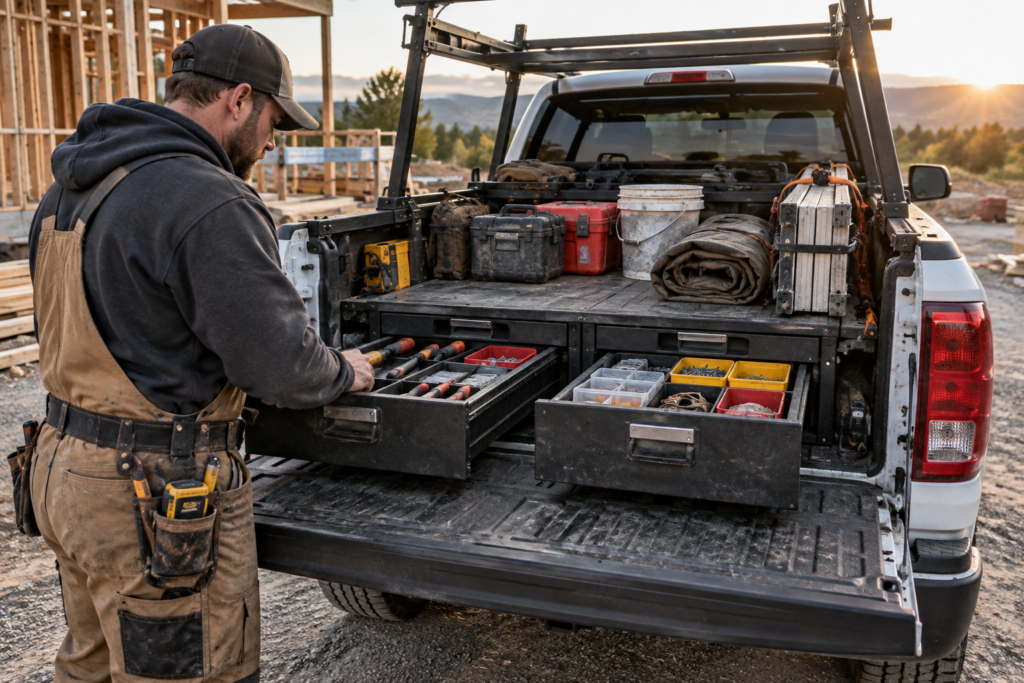
The Small Frustrations Add Up by the End of the Day
One missing tool rarely ruins a contractor’s day. Moving one box to reach something underneath it is not a major problem either. The frustration comes from repeating those small tasks at every stop.
A drill gets placed somewhere different after one job. A container slides behind larger equipment during the drive. Supplies that were easy to find in the morning disappear underneath tools, materials, and packaging by the afternoon.
None of those problems sounds serious on its own. Repeated throughout a full day, however, they make the truck another source of work instead of a tool that supports the job.
A Messy Truck Usually Is Not an Employee Problem
It is easy to look at a disorganized truck and assume someone simply needs to be tidier. In many cases, the real problem is that tools and materials do not have defined places to go.
If every open section of the truck bed becomes temporary storage, organization depends on remembering where each item was placed. That system usually becomes less reliable as the day gets busier.
Proper work truck cargo management solutions can create dedicated locations for commonly carried equipment. The objective is not to make the truck look perfect. It is to make it easier for the person using the vehicle to keep it functional throughout the day.
Searching for Tools Is Work That Produces Nothing
Looking for equipment takes effort without advancing the job. The same is true when a contractor has to unload one item to reach another or repeatedly move supplies around the truck bed.
There is no need to attach an invented productivity number to that problem. Contractors already understand the difference between reaching directly for a tool and spending several minutes checking boxes, moving equipment, and trying to remember where it was placed.
The same organization principle appears in how van shelving improves productivity for contractors. Although trucks and vans require different storage approaches, both benefit when frequently used equipment is easier to locate and access.
Give Frequently Used Equipment a Permanent Home
A useful cargo-management system should reflect how the contractor actually works. Equipment used several times per day should generally be easier to reach than items needed only for occasional tasks.
Storage decisions should also consider equipment size, weight, accessibility, security, and whether certain items need to remain separated. Heavy or awkward equipment may require a different location than small parts or hand tools.
The goal is not to install the greatest possible number of drawers, bins, or compartments. A complicated system can be just as frustrating as no system at all if the layout does not match the work being performed.
Stop Letting the Truck Bed Become One Large Storage Bin
An open truck bed provides useful cargo space, but it can quickly become difficult to manage when everything shares the same area. Tool cases, materials, loose supplies, larger equipment, and job-site gear can begin competing for the same space.
Dedicated drawers, boxes, bins, and other storage systems can create structure while keeping important equipment accessible. The right combination depends on what is carried and how frequently it needs to be reached.
Organization should also be considered as part of the complete work vehicle rather than as an isolated addition. Racks, protection, storage, and other commercial truck accessories should work together instead of creating new access problems.
Some Equipment Needs Dedicated Storage
Not every item belongs in a general cargo area. Valuable tools, job-specific equipment, and supplies that need to remain separated may benefit from a more defined storage location.
Depending on the work being performed, truck tool boxes and storage solutions can be considered as part of that plan. That does not mean every contractor needs the same toolbox, storage configuration, or additional equipment.
The decision should begin with what is actually carried. Storage is most useful when it solves a specific problem instead of simply filling unused space.
Better Organization Makes the End of the Day Easier
The end of the workday is when poor organization can become especially frustrating. After hours of driving, working with customers, loading materials, and completing jobs, a contractor should not have to rebuild the truck just to make the next morning manageable.
A deliberate system makes it easier to return tools to known locations. It can also make it easier to see which supplies need replenishing, notice when equipment is missing, and prepare the truck for the next day’s work.
Cargo management does not eliminate every inconvenience from a demanding workday. It can, however, remove some of the unnecessary friction created by repeatedly searching, moving, and reorganizing equipment.
The Right Setup Depends on What You Actually Carry
Different trades carry very different combinations of hand tools, power tools, fasteners, parts, materials, safety equipment, and larger job-site gear. Even contractors in the same trade may load and access their vehicles differently.
That is why a storage layout should be based on the actual workload instead of copied from a generic truck setup. A system that works well for one contractor may be inconvenient for another if their equipment and access patterns are different.
This workflow-first approach also applies to other commercial vehicles. The guide to commercial van accessories for contractors explains why storage and other vehicle components work best when they are planned around the complete working vehicle rather than purchased independently.
Multiple Vehicles Multiply Organization Problems
A single disorganized truck creates frustration for one operator. Across several vehicles, inconsistent storage can also make it harder for employees to know where commonly used equipment belongs or what should be present in each vehicle.
A repeatable approach to fleet vehicle upfitting can help businesses think more consistently about how working vehicles are organized. That does not require every truck to be identical, especially when different vehicles perform different jobs.
Businesses considering the broader operational role of vehicle organization can also review the fleet van upfitting ROI guide for additional context on planning commercial vehicles around daily work.
Make the Truck Easier to Work From Tomorrow
Cargo management is not about having the cleanest truck in the parking lot. It is about making the vehicle easier to work from at 8 a.m., easier to use throughout the day, and easier to close up when the work is finished.
Before choosing a system, identify which tools are used most often, which equipment is difficult to reach, what tends to move around, and which supplies repeatedly end up without a permanent home. Those recurring problems provide a practical starting point for a better layout.
Talk with Tri-City Custom Upfitters about a cargo-management setup designed around the equipment and materials carried every day, and discuss your cargo-management setup.