

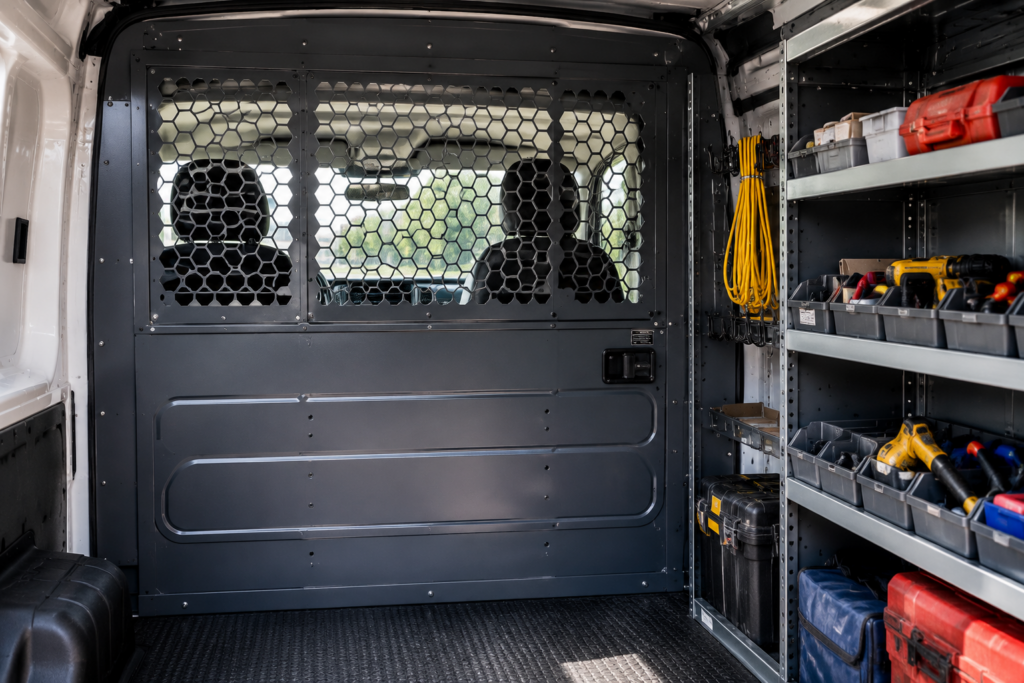
Commercial work vans carry more than just tools and equipment. They function as mobile workspaces that support daily operations, transport valuable inventory, and help technicians serve customers efficiently. While shelving and storage systems often receive the most attention, one of the most important safety upgrades for any work vehicle is a properly installed van partition.
For contractors, fleet managers, and business owners in Cambridge, Kitchener, and Waterloo, understanding the role of van partitions can help improve safety, organization, and overall vehicle performance.
Why Work Vehicle Safety Starts Inside the Van
Many service vehicles transport heavy tools, materials, equipment, and inventory every day. Without proper separation between the cab and cargo area, those items can create serious safety risks.
During sudden braking, sharp turns, or collisions, unsecured cargo can shift forward toward the driver and passengers. Even relatively small tools can become dangerous when moving at vehicle speeds.
Beyond safety concerns, loose equipment often creates noise, distractions, and unnecessary wear on tools and materials. A well-organized vehicle starts with creating a clear separation between occupants and cargo.
For businesses that rely on technicians spending hours on the road each week, reducing these risks should be a priority. Vehicle safety is not only about defensive driving and maintenance. It is also about ensuring the cargo area is configured to protect occupants and support efficient operations.
What a Van Partition Actually Does
A van partition is a barrier installed behind the driver and passenger seats that separates the cab from the cargo area. While simple in concept, partitions provide several important benefits that support both safety and productivity.
The primary purpose is cargo separation. By creating a physical barrier, partitions help prevent tools, materials, and equipment from entering the cab during sudden vehicle movements.
They also improve driver protection by reducing the risk of injury from shifting cargo.
In addition, partitions can reduce road noise coming from the cargo area. Tools and materials often move slightly during transit, creating rattling sounds that can become distracting throughout the day.
Professional van partitions also contribute to better organization by clearly separating workspace functions within the vehicle. The cargo area remains dedicated to equipment storage while the cab remains a clean and comfortable driving environment.
Another benefit is climate control efficiency. When the cargo area is separated from the cab, vehicle heating and air conditioning systems can often maintain a more comfortable temperature for occupants, especially during Ontario’s hot summers and cold winters.
Common Types of Van Partitions
Several partition styles are available, each offering different advantages depending on the type of work being performed.
Solid Partitions
Solid partitions provide the highest level of separation between the cab and cargo area. They offer excellent protection against shifting tools and materials while also helping reduce noise.
Many contractors prefer solid partitions because they create a secure barrier and can improve heating and cooling efficiency within the cab.
For businesses transporting heavy equipment or loose inventory, solid partitions are often considered the safest option.
Mesh Partitions
Mesh partitions use a steel grid design that allows visibility into the cargo area while still providing cargo containment.
These systems are often chosen when airflow and rear visibility are priorities. They can also be a cost-effective solution for certain fleet applications.
Because they are lighter than fully enclosed models, mesh partitions may be suitable for businesses seeking a balance between protection and accessibility.
Windowed Partitions
Windowed partitions combine the protection of a solid barrier with improved visibility through integrated windows.
This option can provide a balance between safety and driver awareness while maintaining cargo separation.
For many service contractors, windowed partitions offer the best combination of comfort, visibility, and protection.
The best choice depends on the type of equipment being transported, daily vehicle usage, and operational preferences.
Safety Risks of Operating Without a Partition
Many businesses underestimate the risks associated with operating a work van without a partition.
One of the most significant concerns is shifting cargo. Heavy tools, ladders, fittings, and equipment can move unexpectedly during normal driving conditions.
Sudden braking creates another hazard. Items stored in the cargo area can continue moving forward even after the vehicle stops, potentially entering the cab area.
Loose tools can also create distractions. Noise from moving equipment may make it more difficult for drivers to focus on the road, especially during long service routes.
Without a partition, businesses may expose drivers and passengers to unnecessary safety risks that could be reduced through a relatively simple vehicle upgrade.
There are also operational consequences. Damaged equipment, broken inventory, and lost productivity can result from poorly secured cargo. These issues often lead to avoidable costs that affect both profitability and customer service.
How Partitions Improve Workflow
While safety is the primary benefit, partitions can also improve day-to-day operations.
A dedicated cargo area encourages better organization by creating clear storage zones for tools, parts, and equipment. Technicians are more likely to maintain organized storage systems when cargo remains separated from the driving area.
Partitions also help maintain a cleaner cab environment. Dust, debris, and jobsite materials remain contained within the cargo section rather than spreading throughout the vehicle.
For technicians who spend long hours driving between service calls, a quieter and more organized cab can contribute to a more comfortable workday.
Improved organization often translates directly into better efficiency and faster access to equipment at job sites.
When combined with properly designed shelving systems, partitions help create a professional mobile workspace that supports consistent daily operations.
Why Partitions Are Part of a Complete Upfitting Strategy
Partitions are most effective when combined with other vehicle organization solutions.
A complete van upfitting strategy may include shelving systems, storage drawers, ladder racks, cargo management equipment, and workflow-focused vehicle layouts.
While shelving helps organize equipment, partitions help secure and separate that equipment from vehicle occupants. Together, these solutions create a safer and more productive mobile workspace.
Businesses investing in professional vehicle upfitting often find that combining multiple solutions delivers greater benefits than relying on a single upgrade alone.
The result is a vehicle that supports efficiency, safety, and long-term operational performance.
For contractors interested in improving overall organization, solutions such as How Van Shelving Improves Productivity for Contractors can complement partition installations by creating dedicated storage zones throughout the cargo area.
Choosing the Right Partition for Your Trade
Different industries have different storage requirements, which can influence partition selection.
HVAC contractors often carry larger equipment, fittings, and inventory that benefit from strong cargo separation and organized storage systems.
Electrical contractors frequently transport numerous tools and components that require both security and easy access.
Plumbing professionals may carry pipe, fittings, equipment, and replacement parts that make cargo containment especially important.
Telecommunications technicians often benefit from organized storage combined with partitions that reduce distractions during frequent service calls.
Delivery fleets may prioritize durability, driver comfort, and efficient access between the cab and cargo area depending on operational requirements.
Businesses evaluating broader vehicle improvements may also find value in Why Cambridge Businesses Invest in Professional Van Upfitting when planning future fleet upgrades.
Selecting the right partition starts with understanding how the vehicle is used each day and what types of materials it carries.
Next Step for Cambridge Area Businesses
For businesses throughout Cambridge, Kitchener, and Waterloo, van partitions are one of the most practical upgrades available for improving work van safety and organization.
Whether operating a single service vehicle or managing a growing fleet, the right partition can help protect drivers, reduce distractions, improve organization, and support more efficient daily operations.
When combined with shelving, storage systems, and other upfitting solutions, van partitions become a key component of a safer and more productive mobile workspace.
Ready to find the right partition solution for your vehicle? Book a consultation to determine the ideal setup for your work van or commercial fleet.